Wednesday, January 18, 2012

Display Published Date in SharePoint Search Result

In SharePoint search result, the last modified date of an articel (page) is displayed after the page link by default:


How to change this default behavior? Let's say, display the date from a page's column (field) named "Published Date". You can do it without any coding! Following are the configuration steps to achieve this:

1. Verify the property internal name. You can go the library setting page, click the "Published Date" column, search the "Field" query string inside the URL, and that's column's internal name. It's "Publish%5x0020%5On":
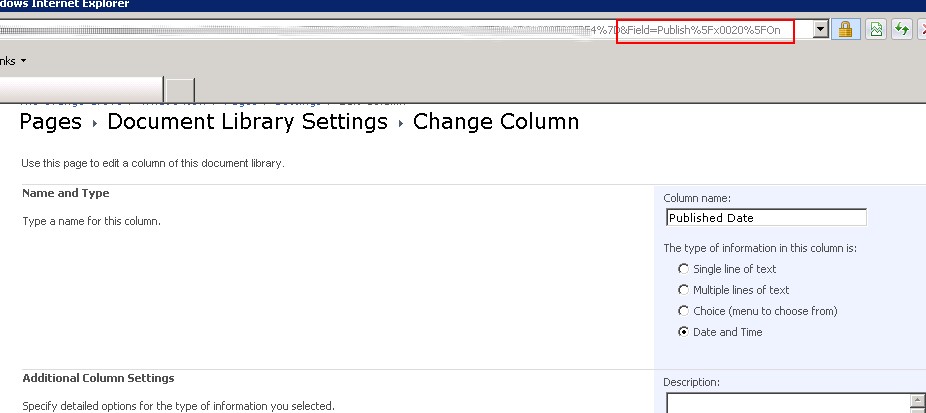


2. Make that "PublishDate" property enable for search result web part to display:
2.1. Open SharePoint Centra Admin -> Manage Application -> Manage Service Application -> Search Application
2.2. Click "Metadate Properties" under "Queries and Results" category on the left panel
2.3. Click "New Managed Property" on the tool bar
2.4. Type "PublishDate" as property name, add "ows_Published_x0020_On" to the mapping, check "Allow this property to be used in scopes" and "Add managed property to custom results set retrieved on each query"


3. Re-crawl the whole content: click "Content Sources" under Crawling category, select the target content source and click "Start Full Crawl". Wait for crawling to be completed.

4. Update Search Core Result WebPart on search result page to display the newly added search property. Because not all content has such column (field), we need to conditionally display this field if it exists, otherwise show the original last modified date.


4.1. Edit the "Search Core Resul" WebPart on the search page, under "Display Properties" category, uncheck "Use Location Visualization".
4.2. Copy the value of "Fetched Proerpties" and paste it to a notepad, add <column name="PublishDate"> in front of <column name="Write"> then paste back the whole string (one line) as "Fetched Proerpties" value, something like:
<root xmlns:xsi="http://www.w3.org/2001/XMLSchema-instance"><Columns><Column Name="WorkId"/>...
<Column Name="PublishDate"/><Column Name="Write"/>...
4.3. Click "XML Editor", search for:
<xsl:call-template name="DisplayString">
<xsl:with-param name="str" select="write"></xsl:with-param>
</xsl:call-template>
Replaced by:
<xsl:choose>
<xsl:when test="string-length(publishdate) &gt; 0">
<xsl:call-template name="DisplayString">
<xsl:with-param name="str" select="publishdate"></xsl:with-param>
</xsl:call-template>
<xsl:otherwise>
<xsl:call-template name="DisplayString">
<xsl:with-param name="str" select="write"></xsl:with-param>
</xsl:call-template>
</xsl:otherwise>
</xsl:when></xsl:choose>
Now the "Published Date" is shown for those pages with this field defined, and last modified date displays for those pages without this field.

Note that "publishdate" in the XSLT condition is all lower case. I defined it as "PublishDate" in Search property, and I assumed it remains the same in search return. But that's not the case. Search application always returns a xml with all lower case property name. This can be verified by showing the original search result. In order to see the oringal search result, simply use the following xml for the Search Core Result WebPart:
<xsl:stylesheet version="1.0" xmlns:xsl="http://www.w3.org/1999/XSL/Transform">
<xsl:output method="xml" version="1.0" encoding="UTF-8" indent="yes"/>
<xsl:template match="/">
<xmp><xsl:copy-of select="*"/></xmp>
</xsl:template>
</xsl:stylesheet>
The screen-shot of the original search return:

Friday, December 23, 2011

SharePoint 2010 Migration

After a few months of preparation and testing we finally upgraded our production portal from MOSS 2007 to SharePoint 2010 about two weeks ago. There’s no major issue reported/found so far, and the overall feedback from the end users is positive.

The database approach was used in our migration, i.e. install a new SharePoint 2010 farm and mount the old MOSS 2007 databases. The migration process looks straightforward: run preupgradecheck then fix the issues, and run Test-SPContentDatabase then fix the issues, and finally run Mount-SPContentDatabase. Fixing those issues wasn't too hard but just a matter of time.

We had spent quite a lot of effort on content analysis and cleanup with our 60+G of content databases. At the end all our custom WebParts, dlls, user controls and some other SharePoint resources were repackaged into one solution called "SP2010Migration" that only builds one solution package for all.


The SP2010Migration solution package was supposed to deployed only once and that’s all. It shouldn’t be used anymore unless to build a new farm from scratch again. There’s no Feature in the solution package because it may bring trouble in later deployment. So in the future we can still package any WebPart or component into a Feature without concern of Feature conflict.

One interesting thing is that all user controls loaded by SmartParts were still working fine after migration. But we got some issues with the DataFormWebPart. For example the relative link was’t wrong after migration, and we had to write a console app to replace all "{@FileRef}" by "/{@FileRef}" inside each DFWP’s XSLT across the whole farm.

Another DFWP issue seemed to be more confusing where we only saw error in the DFWP page:

Unable to display this Web Part. To troubleshoot the problem, open this Web page in a Microsoft SharePoint Foundation-compatible HTML editor such as Microsoft SharePoint Designer. If the problem persists, contact your Web server administrator. Correlation ID:…

By Correlation ID we could easily find out the error detail from ULS log:

Error while executing web part: System.StackOverflowException: Operation caused a stack overflow. At Microsoft.Xslt.NativeMethod.CheckForSufficientStack() at SyncToNavigator(XPathNavigator , XPathNavigator ) at …

I tested the setting locally and everything seemed to be okay. How come a out-of-box SharePoint WebPart got a “stack overflow” error in production and it used to be working fine before migration? It turned out that time-out scenario occurred internally during XSL transform process in DFWP in production environment. That time-out threshold is only 1-second which means anything longer than 1 second will cause the error. We have a big list in our production server and the DFWP displays hundreds of rows in a big table which caused the time-out error.

That’s something new in SharePoint 2010 and also something annoying by Microsoft. It's great to introduce new stuff but it's also important to keep old stuff work right? Why not just turned off that new “time-out” feature by default and let end users to have an option to set it?

The worst thing is that there's no way to change that 1-second time-out setting! Microsoft provided "three solutions" for this issue:

1.) Tune XSL to get shorter transform time.
2.) Don't use DFWP instead use other WebPart.
3.) Write code to inherit DFWP and build your own.

Following the instruction we finally got the DFWP back after tweaking its settings, e.g. less columns and smaller page size. That's of course not an ideal way to solve the problem. We hope Microsoft could provide a better solution on this issue.

[2012-3 Update]: The time-out value of a DFWP now is configurable in Farm level with latest SharePoint CU. Refer to this.

Wednesday, December 07, 2011

A SharePoint Double Hop Issue

A SharePoint DataForm Web Part is not working properly sometimes after migrating from SharePoint 2007 to a SharePoint 2010 environment. Oringal ShaerPoint 2007 farm only has one front-end server and the new SharePoint 2010 farm includes two front-end servers and one application server. NTLM authentication is used in both SharePoint 2007 and 2010 environment.

The DataForm web part is working okay in SharePoint designer, and it's invoking the SharePoint Profile Service to retrieve some user profile data.

The ULS log shows (401) Unauthorized error:


w3wp.exe (0x1150) Error while executing web part: System.Net.WebException: The remote server returned an error: (401) Unauthorized. at System.Net.HttpWebRequest.GetResponse() at ....


Apparently that service call was routed to the other front-end server and then got access error. We verify that the SharePoint Web Services in both front-end servers do have anonymous access enabled. So why access error still happened?

Since the user has already authenticated to the site, the service call inside the DataForm webpart would automatically impersonate the original user instead of accessing outside as anonymous user, and that service call would fail in the other front-end server due to the NTLM setup in our environment. This is a typical NTLM double-hop issue.

Why the service call is not ending at local machine? Well it does sometimes and that's why it works sometimes. The problem is caused by the round robin DNS setup. To resolve the problem, simply add related entries to front-end servers' hosts file with domain name(s) pointing to local server. Then such service calls will always go to local machine and the double-hop issue will be gone.

Wednesday, November 30, 2011

Using Powershell to Update SharePoint 2010 User Profile

In previous post a small piece of code demos a simple way to update the user profile picture by object model. The same task can also be achieved easily using Powershell:
$userAccount = "SP2010\test"
$newPictureURL = "http://SP2010Site/Photos/test.jpg"
$site = Get-SPSite("http://SP2010Site")
$context = Get-SPServiceContext $site
$profileManager = New-Object Microsoft.Office.Server.UserProfiles.UserProfileManager($context)
$userProfile = $profileManager.GetUserProfile($userAccount)
$userPicture["PictureURL"].Value = $newPictureURL
$userProfile.Commit()
Actually there's some improvement in SharePoint 2010 user photo management. Instead of one picture being used everywhere in SharePoint 2007, SharePoint 2010 maintains three different profile pictures to be used in different contexts. Three images will be created when a user uploaded a picture which are stored in a library folder inside MySite's root site: http://mysite/User Photos/Profile Picture. You can get more detailed SharePoint 2010 photo management from this MSDN blog.

What about a SharePoint 2010 environment upgraded from SharePoint 2007? All the user pictures are still pointing to the old location. However, you can use following Powershell script to migrate all those pictures:
Update-SPProfilePhotoStore -MySiteHostLocation http://SPMySite/
What it does is rebuild all user pictures from previous verion. For example, a user with AD account of SP2010\test has the picture location of http://sp2010site/Profile Pictures/test.jpg. Then three images will be created after above Powershell command execution:
1. http://mysite/User Photos/Profile Pictures/SP2010_test_LThumb.jpg
-- size: 148x148 pixel
-- exmaple of usage: mysite title image
2. http://mysite/User Photos/Profile Pictures/SP2010_test_MThumb.jpg
-- size: 96x96
-- exmaple of usage: people search result image
3. http://mysite/User Photos/Profile Pictures/SP2010_test_SThumb.jpg
-- size: 36x36 small image
-- exmaple of usage: mysite colleague photo

One common scenario is to update test accounts' email address so testers/developers can get the email notification in the test environment. User's email address used by SharePoint to send the email notification is not directly from the user profile, instead it's from a user record in the User Information List tied to top site collection (the user info list data could be overridden by user profile service). In order to change a user's email address you have to modify the list item value in the user information list for a given site:
$web = Get-SPWeb http://sp2010site
$userInfoList = $web.Lists | where { $_.Title -eq "User Information List" }
$userAccount = $userInfoList.Items | where { $_["Account"] -eq "sp2010\test" }
$userAccount["Work e-mail"] = "whatevername@whatever.com"
$userAccount.Update()
Be aware that the modification could be overridden by user profile service's scheduled synchronization if you have user profile service enabled.

This is not related to user profile, but it's also common issue in a migrated SharePoint environment. A SharePoint 2010 farm migrated from SharePoint 2007 without visual upgrade will keep the old UI. But you will notice a new site created after migration (root site or subsite) would always use the new SharePoint 2010 UI. In case you just want to keep the old UI and don't have a short-term plan for UI upgrade, how to revert the new created site back to previous version? Simply a few lines of script:
$web = Get-SPWeb http://sp2010site/newsite
$web.UIVersion = 3
$web.MasterUrl = "/newsite/_catelogs/masterpage/homepagev3.master"
$web.AlternateCssUrl = "newsite/style library/customlayout.css"
$web.Update()

For more hands-on Powershell scripts used in SharePoint environment, refer to this codeplex project complied by a few SharePoint gurus.

Tuesday, November 29, 2011

SharePoint Server 2010 User Profile

There's no big change between SharePoint Server 2010 and MOSS 2007 in terms of User Profile management. The MOSS 2007 user profile database attached to SSP (Shared Service Provider) can be mounted directly to SharePoint Server 2010 User Profile Service Application. The mount process actually upgrades the MOSS 2007 user profile database. You will notice some new tables and columns are added in the backend database. Following image shows the scheme change made on the UserProfile_Full table in user profile database.

The User Information List is still there in each top site collection where SharePoint foundation manitains the basic user data. A record will be added to the User Information List when a user or a group is first referenced by the SharePoint environment. The initial User Information data, like title, user login, email address, etc., are imported from the authentication provider such as Active Directory. In SharePoint Foundation 2010 the User Information List is updated when you modify user info through "My Settings". All User Information List data are stored in the UserInfo table in content database:

Once the User Profile Service is enabled in SharePoint Server 2010, the User Information List became read-only for end user except the "Mobile Number" property, and user profile database is updated when the user modifying "My Settings", instead of the User Information List (UserInfo table). A timer job is responsible for replicating the user profile data to User Information data for each top site collection, and User Information List data will be overridden unless the corresponding property is not set to "Replicable" in User Profile Service:

Sometime it would cause some confusion when the User Information data are not synced to the User Profile data. Remember regular SharePoint sites always get user info from the User Information List but the User Profile content are the original data source when User Profile Service is enabled.

There's slight difference in SharePoint 2010 when accessing or updating the user profile data comparing with SharePoint 2007. In MOSS 2007, Microsoft.Office.Server.ServiceContext is available and you can create a UserProfileManager object from a ServiceContext. In SharePoint 2010 ServiceContext is replaced by the new Microsoft.SharePoint.SPServiceContext:

void UpdateUserProfiles(string siteUrl)
{
string userName = null;
using (SPSite spSite = new SPSite(siteUrl))
{
//ServiceContext is obsolete in SharePoint 2010
//UserProfileManager userProfileManager = new UserProfileManager(ServerContext.GetContext(spSite));

UserProfileManager userProfileManager = new UserProfileManager(SPServiceContext.GetContext(spSite));

foreach (UserProfile profile in userProfileManager)
{
string account = Convert.ToString(profile[PropertyConstants.AccountName].Value);
if (string.IsNullOrEmpty(account) || account.IndexOf("\\") <= 0)
continue;
userName = account.Substring(account.IndexOf("
\\"));
profile[PropertyConstants.PictureUrl].Value = GetUserPhotoLocation(userName);
profile.Commit();
}
}
}
The method simply goes through each user profile, and updates the user photo by some custom logic (GetUserPhotoLocation method). Notice Microsoft.Office.Server.UserProfiles has become a separate dll in SharePoint 2010, so in order to get above code compiled you need to add Microsoft.Office.Server and Microsoft.Office.Server.UserProfiles to the references.

Thursday, October 27, 2011

Invoke SharePoint Workflow Programmatically

There's some restricted SharePoint sites and content in your SharePoint environment, and users can only interact with secure SharePoint resources through custom webpart(s). A typical example is performance review system. For simplicity let's say each department has a site or subsite to store the review data. You create a SPList for each year's review like PerformanceReview-2011, PerformanceReview-2012, etc. Only the management team members of a department can have direct access to the department performance review site. Every employee can input the data and respond manager's question/review through a custom webpart. Usually RunWithElevatedPrivileges is used inside the WebPart to get through the permission issue for SPList content update as code below:
    SPSecurity.RunWithElevatedPrivileges(delegate()
    {
        using (SPSite site = new SPSite(siteID))
        {
            using (SPWeb web = site.OpenWeb(webID))
            {
                SPList list = web.Lists.TryGetList(listName);
                //Update List Item ...
            }
        }
    });
A workflow associated with the List is supposed to automatically kick off doing some extra stuff such as assigning task to corresponding managers. The problem is that the execution context of above code is system account, and updating List Item with System account won't trigger the workflow. So you have to start the workflow manually inside the WebPart:
    // Start a workflow manually since system account won't trigger workflow automatically
    private static void StartWorkflow(SPListItem listItem, string workflowName)
    {
        try
        {
            var listWorkflowAssociations = listItem.ParentList.WorkflowAssociations;
            foreach (SPWorkflowAssociation wfAssoication in listWorkflowAssociations)
            {
                if (wfAssoication.Name == workflowName)
                {
                    listItem.Web.Site.WorkflowManager.
                      StartWorkflow(listItem, wfAssoication, wfAssoication.AssociationData, true);
                    break;
                }
            }
        }
        catch (Exception ex)
        {
            // Exception handling
        }
    }
Bear in mind that the Associator, Initiator and Current User inside Workflow context all are system account with such implementation. You have to use People field defined in List Item to reference the original user.

Friday, October 21, 2011

Event Receivers Issue After Migration From SharePoint 2007 to SharePoint 2010

We have a SharePoint 2007 site created by Reservations Template (part of WSS 3.0 Application Templates). The site is used for company-wide meeting room booking. After migrating to SharePoint 2010 (database-attachment approach) the room-booking system was not working properly. Same resource can be doubly booked and sometimes you can't book some resources while they show as available in the UI.

After some digging I found the problem was caused by the Event Receiver associated with the Reservations List. Originally in SharePoint 2007 the Reservations List has registered the Event Receivers with assembly of "ReservationEventHandler, Version=12.0.0.0, Culture=neutral, PublicKeyToken=71e9bce111e9429c". That assembly registration became "ReservationEventHandler, Version=14.0.0.0, Culture=neutral, PublicKeyToken=71e9bce111e9429c" after migration for some reason. To fix the problem, we simply correct the List's event registry:
static void FixReservationEventReceivers(SPSite site, string webUrl, string listName)
{
    using (SPWeb web = site.OpenWeb(webUrl))
    {
        bool hasAddingEvent = false, hasDeletingEvent = false, hasUpdatingEvent = false;
        SPList list = web.Lists.TryGetList(listName);
        List<SPEventReceiverDefinition> invalidReceivers = new List<SPEventReceiverDefinition>();
        foreach (SPEventReceiverDefinition item in list.EventReceivers)
        {
            if (item.Assembly.Contains("ReservationEventHandler") && item.Assembly.Contains("Version=14.0.0.0"))
                invalidReceivers.Add(item);
            if (item.Assembly.Contains("ReservationEventHandler") && item.Type == SPEventReceiverType.ItemAdding)
                hasAddingEvent = true;
            if (item.Assembly.Contains("ReservationEventHandler") && item.Type == SPEventReceiverType.ItemDeleting)
                hasDeletingEvent = true;
            if (item.Assembly.Contains("ReservationEventHandler") && item.Type == SPEventReceiverType.ItemUpdating)
                hasUpdatingEvent = true;
        }
        foreach (var item in invalidReceivers)
        {
            item.Delete();
        }

        string assemblyName = "ReservationEventHandler, Version=12.0.0.0, Culture=neutral, PublicKeyToken=71e9bce111e9429c";
        string className = "Microsoft.SharePoint.ApplicationTemplates.ReservationEventHandler";
        if (!hasAddingEvent)
            list.EventReceivers.Add(SPEventReceiverType.ItemAdding, assemblyName, className);
        if (!hasDeletingEvent)
            list.EventReceivers.Add(SPEventReceiverType.ItemDeleting, assemblyName, className);
        if (!hasUpdatingEvent)
            list.EventReceivers.Add(SPEventReceiverType.ItemUpdating, assemblyName, className);
    }
}
You may wonder what those event receivers do with the List item. The explanation is lengthy but not worthy knowing to be honest. The template was not well designed and implemented in my opinion. I spent quite a bit of time to customize and optimize the template. Actually we don't need those event receivers anymore after my modification and the performance of the booking system has been improved significantly since then (hundreds of thousands of records in our Reservations List). I may write some notes about that later.

Monday, October 17, 2011

XsltListViewWebPart Custom View and XSL

SharePoint 2010 introduces a new XsltListViewWebPart that is inherited from DataFormWebPart. One great feature in XsltListViewWebPart is that you can define query and fields easily and clearly. Following XML declaration demonstrates how to set a XsltListViewWebPart to show open tasks assign to current user, and link to external custom XSL to display the items.
<WebPartPages:XsltListViewWebPart runat="server" IsIncluded="True" GhostedXslLink="main.xsl" 
    ListDisplayName="Tasks" NoDefaultStyle="TRUE" ViewFlag="8" Title="Tasks" PageType="PAGE_NORMALVIEW"  
    Default="FALSE" DisplayName="Open Tasks" DetailLink="Lists/Tasks" __markuptype="vsattributemarkup" 
    partorder="3"  viewcontenttypeid="0x" >
    <XmlDefinition>
        <View MobileView="TRUE" Type="HTML" DisplayName="All Tasks" Url="Lists/Tasks/AllItems.aspx" 
            Level="1" BaseViewID="1" ContentTypeID="0x" ImageUrl="/_layouts/images/issues.png">
            <Query>
                <OrderBy>
                    <FieldRef Name="Status" Ascending="TRUE"/>
                </OrderBy>
                <GroupBy></GroupBy>
                <Where>
                    <And>
                        <Eq>
                            <FieldRef Name="AssignedTo"/><Value Type="Integer"><UserID/></Value>
                        </Eq>
                        <Neq>
                            <FieldRef Name="Status"/><Value Type="Text">completed</Value>
                        </Neq>
                    </And>
                </Where>
            </Query>
            <ViewFields>
                <FieldRef Name="LinkTitleNoMenu"/>
                <FieldRef Name="Status"/>
                <FieldRef Name="Priority"/>
                <FieldRef Name="DueDate"/>
                <FieldRef Name="PercentComplete"/>
            </ViewFields>
            <RowLimit Paged="TRUE">30</RowLimit>
            <Toolbar Type="Freeform" />
        </View>
    </XmlDefinition>
    <XslLink>Site Assets/XSL/OpenTask.xsl</XslLink>
    <parameterbindings>
        <ParameterBinding Name="dvt_sortdir" Location="Postback;Connection"/>
        <ParameterBinding Name="dvt_sortfield" Location="Postback;Connection"/>
        <ParameterBinding Name="dvt_startposition" Location="Postback" DefaultValue=""/>
        <ParameterBinding Name="dvt_firstrow" Location="Postback;Connection"/>
        <ParameterBinding Name="OpenMenuKeyAccessible" Location="Resource(wss,OpenMenuKeyAccessible)"/>
        <ParameterBinding Name="open_menu" Location="Resource(wss,open_menu)"/>
        <ParameterBinding Name="select_deselect_all" Location="Resource(wss,select_deselect_all)"/>
        <ParameterBinding Name="idPresEnabled" Location="Resource(wss,idPresEnabled)"/>
        <ParameterBinding Name="NoAnnouncements" Location="Resource(wss,noXinviewofY_LIST)"/>
        <ParameterBinding Name="NoAnnouncementsHowTo" Location="Resource(core,noXinviewofY_DEFAULT)"/>
        <ParameterBinding Name="AddNewAnnouncement" Location="Resource(wss,addnewitem)"/>
        <ParameterBinding Name="MoreAnnouncements" Location="Resource(wss,moreItemsParen)"/>
        <ParameterBinding Name="UserID" Location="CAMLVariable" DefaultValue="CurrentUserName"/>
    </parameterbindings>
</WebPartPages:XsltListViewWebPart>
The custom XSL does three things:

1. Replace priority string from "(2) Normal" by "Normal"
2. Replace default empty message "There are no items to show in this view of the {ListName} list. To add a new item, click 'New'." by "No item"
3. Replace the SP2010 Add New Item icon to old SP2007 icon

The XSL source:
<xsl:stylesheet xmlns:x="http://www.w3.org/2001/XMLSchema" xmlns:d="http://schemas.microsoft.com/sharepoint/dsp" 
                version="1.0" exclude-result-prefixes="xsl msxsl ddwrt" 
                xmlns:ddwrt="http://schemas.microsoft.com/WebParts/v2/DataView/runtime" 
                xmlns:asp="http://schemas.microsoft.com/ASPNET/20" 
                xmlns:__designer="http://schemas.microsoft.com/WebParts/v2/DataView/designer" 
                xmlns:xsl="http://www.w3.org/1999/XSL/Transform" 
                xmlns:msxsl="urn:schemas-microsoft-com:xslt" 
                xmlns:SharePoint="Microsoft.SharePoint.WebControls" 
                xmlns:ddwrt2="urn:frontpage:internal" 
                xmlns:o="urn:schemas-microsoft-com:office:office">
    <xsl:include href="/_layouts/xsl/main.xsl"/>
    <xsl:include href="/_layouts/xsl/internal.xsl"/> 

    <xsl:template name="FieldRef_body.Priority" match="FieldRef[@Name='Priority']" mode="body">
                <xsl:param name="thisNode" select="."/>
                    <xsl:choose>
                      <xsl:when test="starts-with($thisNode/@*[name()=current()/@Name], '(1) ')">
              <xsl:value-of select="substring-after($thisNode/@*[name()=current()/@Name], '(1) ')"/>
                      </xsl:when>
            <xsl:when test="starts-with($thisNode/@*[name()=current()/@Name], '(2) ')">
              <xsl:value-of select="substring-after($thisNode/@*[name()=current()/@Name], '(2) ')"/>
            </xsl:when>
            <xsl:when test="starts-with($thisNode/@*[name()=current()/@Name], '(3) ')">
              <xsl:value-of select="substring-after($thisNode/@*[name()=current()/@Name], '(3) ')"/>
            </xsl:when>
                    </xsl:choose>
    </xsl:template>
  
  <xsl:template name="EmptyTemplate">
    <tr>
      <td class="ms-vb" colspan="99">No item</td>
    </tr>
  </xsl:template>

  <xsl:template name="Freeform" >
    <xsl:param name="AddNewText" />
    <xsl:param name="ID" />
    <xsl:variable name="Url">
      <xsl:choose>
        <xsl:when test="List/@TemplateType='119'">
          <xsl:value-of select="$HttpVDir" />/_layouts/CreateWebPage.aspx?List=
          <xsl:value-of select="$List" />&amp;RootFolder=
          <xsl:value-of select="$XmlDefinition/List/@RootFolder" />
        </xsl:when>
        <xsl:when test="$IsDocLib">
          <xsl:value-of select="$HttpVDir" />/_layouts/Upload.aspx?List=
          <xsl:value-of select="$List" />&amp;RootFolder=
          <xsl:value-of select="$XmlDefinition/List/@RootFolder" />
        </xsl:when>
        <xsl:otherwise>
          <xsl:value-of select="$ENCODED_FORM_NEW" />
        </xsl:otherwise>
      </xsl:choose>
    </xsl:variable>
    <xsl:variable name="HeroStyle">
      <xsl:choose>
        <xsl:when test="Toolbar[@Type='Standard']">display:none</xsl:when>
        <xsl:otherwise></xsl:otherwise>
      </xsl:choose>
    </xsl:variable>
    <xsl:if test="$ListRight_AddListItems = '1' and (not($InlineEdit) or $IsDocLib)">
      <table id="Hero-{$WPQ}" width="100%" cellpadding="0" cellspacing="0" border="0" style="{$HeroStyle}">
        <tr>
          <td colspan="2" class="ms-partline">
            <img src="/_layouts/images/blank.gif" width="1" height="1" alt="" />
          </td>
        </tr>
        <tr>
          <td class="ms-addnew" style="padding-bottom: 3px">
            <img src="/_layouts/images/rect.gif" alt="Add a new item" />
            <xsl:text disable-output-escaping="yes" ddwrt:nbsp-preserve="yes">&amp;nbsp;</xsl:text>
            <xsl:choose>
              <xsl:when test="List/@TemplateType = '115'">
                <a class="ms-addnew" id="{$ID}-{$WPQ}" href="{$Url}" 
                   onclick="javascript:NewItem2(event, &quot;{$Url}&quot;);javascript:return false;" target="_self">
                  <xsl:value-of select="$AddNewText" />
                </a>
              </xsl:when>
              <xsl:otherwise>
                <a class="ms-addnew" id="{$ID}" href="{$Url}" 
                   onclick="javascript:NewItem2(event, &quot;{$Url}&quot;);javascript:return false;" target="_self">
                  <xsl:value-of select="$AddNewText" />
                </a>
              </xsl:otherwise>
            </xsl:choose>
          </td>
        </tr>
        <tr>
          <td>
            <img src="/_layouts/images/blank.gif" width="1" height="5" alt="" />
          </td>
        </tr>
      </table>
      <xsl:choose>
        <xsl:when test="Toolbar[@Type='Standard']">
          <script type='text/javascript'>
            if (typeof(heroButtonWebPart <xsl:value-of select="$WPQ" />) != "undefined") {
            <xsl:value-of select="concat(' var eleHero = document.getElementById(&quot;Hero-', $WPQ, '&quot;);')" />
            if (eleHero != null) eleHero.style.display = ""; }
          </script>
        </xsl:when>
        <xsl:otherwise></xsl:otherwise>
      </xsl:choose>
      <xsl:if test="List/@TemplateType = '115'">
        <script type='text/javascript'>
          if (typeof(DefaultNewButtonWebPart <xsl:value-of select="$WPQ" />) != "undefined") {
          <xsl:value-of select="concat(' var eleLink = document.getElementById(&quot;', $ID, '-', $WPQ, '&quot;);')" />
          if (eleLink != null) { DefaultNewButtonWebPart <xsl:value-of select="$WPQ" /> (eleLink); } }
        </script>
      </xsl:if>
    </xsl:if>
  </xsl:template>
</xsl:stylesheet>
Note that linking external XSL in XsltListViewWebPart would have performance impact since a compilation process would occur each time the WebPart is loaded, and the WebPart content can't be cached anymore. So it would be better to use inline XSL if there're many WebParts in a page.

Thursday, October 13, 2011

Using SharePoint WebProvisioned Event to Update Newly Created Site

I've been working on a SharePoint 2010 Site Definition that includes a bunch of Lists and a default page, and the new site (SPWeb) built by the Site Definition should keep old SharePoint 2007 UI because the users are used to the old looks and feels. A DataFormWebPart on the default page shows recent updates for a few different Lists. The problem is that those ListIDs are hard-coded in side DFWP, but ListIDs will be changed when a new site is created. Some tweaks on DFWP, e.g. changing ListID to ListName, could make it reusable, but that only works for single datasource but won't work for multiple datasources (AggregateDataSource). I tried AllUsersWebPart and View approach to provision the WebPart instance to the default page but without luck.

To resolve the problem I use tokens in the DFWP and replace those tokens with real ListIDs after site is created, as following:
<SharePoint:SPDataSource runat="server" DataSourceMode="List" UseInternalName="true" 
            UseServerDataFormat="true" selectcommand="&lt;View&gt;&lt;/View&gt;">
    <SelectParameters><asp:Parameter Name="ListID" DefaultValue="$LIST_TOKEN:{Project Documents}$"/>
    </SelectParameters>
    <DeleteParameters><asp:Parameter Name="ListID" DefaultValue="$LIST_TOKEN:{Project Documents}$"/>
    </DeleteParameters>
    <UpdateParameters><asp:Parameter Name="ListID" DefaultValue="$LIST_TOKEN:{Project Documents}$"/>
    </UpdateParameters>
    <InsertParameters><asp:Parameter Name="ListID" DefaultValue="$LIST_TOKEN:{Project Documents}$"/>
    </InsertParameters>
</SharePoint:SPDataSource>
In above DFWP configuration the "$LIST_TOKEN:{Project Documents}$" token will be replaced by the List/Library ID of "Project Documents". The other issue is that sometimes some WebParts on the default page are automatically closed after the new site is provisioned for some unknown reason. So there're a few issues I need to fix for the Site Definition:

1. Convert SP2010 site back to SharePoint 2007 UI
2. Change master page and css
3. Change DFWP's list Ids on default page
4. Open closed WebParts if exists

The solution is use SPWebEventReceiver to update site properties and the default page:
using System;
using System.Security.Permissions;
using System.Text.RegularExpressions;
using System.Web.UI.WebControls.WebParts;

using Microsoft.SharePoint;
using Microsoft.SharePoint.WebPartPages;

namespace SiteDefinition
{
    /// <summary>
    /// Web Provision Events
    /// </summary>
    public class INGProjectSiteEventReceiver : SPWebEventReceiver
    {
        /// <summary>
        /// Update a site (SPWeb) when it's created
        /// 1. Convert site back to SharePoint 2007 UI
        /// 2. Update master page and css file
        /// 3. Update DFWP's list Ids on default page
        /// 4. Open closed WebParts if exists
        /// </summary>
        public override void WebProvisioned(SPWebEventProperties properties)
        {
            if (properties.Web.WebTemplateId == 11001) // Only applied to targetted template
            {
                properties.Web.UIVersion = 3;
                properties.Web.MasterUrl = properties.Web.Site.RootWeb.MasterUrl;
                properties.Web.AlternateCssUrl = properties.Web.Site.RootWeb.AlternateCssUrl;
                properties.Web.Update();

                UpdateDefaultPageWebPartListIDs(properties.Web);
                OpenClosedWebParts(properties.Web);
            }

            base.WebProvisioned(properties);   
        }

        /// <summary>
        /// Update default page's DataFormWebParts' ListID property with corresponding List ID (GUID)
        /// </summary>
        private void UpdateDefaultPageWebPartListIDs(SPWeb web)
        {

            SPFile defaultPage = web.RootFolder.Files["Default.aspx"];
            if (defaultPage.Exists)
            {
                System.Text.ASCIIEncoding coding = new System.Text.ASCIIEncoding();
                byte[] byteArrayText = defaultPage.OpenBinary();

                if (byteArrayText.Length > 0)
                {
                    string origHtml = coding.GetString(byteArrayText);
                    string newHtml = ReplaceDataSourceToken(origHtml, web);
                    if (!string.IsNullOrEmpty(newHtml))
                    {
                        byte[] newByteArray = coding.GetBytes(newHtml);
                        defaultPage.SaveBinary(newByteArray);
                    }
                }
            }
        }

        /// <summary>
        /// Pre-defined tokens are used inside default page and we need to replace them here:
        /// e.g. "\$LIST_TOKEN:{Tasks}\$" will be replaced with Tasks' List ID (GUID)
        /// </summary>
        private string ReplaceDataSourceToken(string text, SPWeb web)
        {
            string pattern = @"\$LIST_TOKEN:{.*?}\$";
            Match mc = Regex.Match(text, pattern);
            if (mc.Success)
            {
                while (mc.Success)
                {
                    if (!string.IsNullOrEmpty(mc.Value))
                    {
                        string listName = mc.Value.Substring(13, mc.Length - 15);

                        SPList list = web.Lists.TryGetList(listName);
                        if (list != null)
                            text = string.Format("{0}{1}{2}",  
                                text.Substring(0, mc.Index), list.ID.ToString("B"), text.Substring(mc.Index + mc.Length));
                        else
                            text = string.Format("{0}$LIST_NOT_FOUND:[{1}]{2}",
                                text.Substring(0, mc.Index), listName, text.Substring(mc.Index + mc.Length);
                        
                        mc = Regex.Match(text, pattern);
                    }
                }
            }
            return text;
        }

        /// <summary>
        /// Sometimes WebParts are closed automatically and this method opens all closed webParts in the default page
        /// </summary>
        private void OpenClosedWebParts(SPWeb web)
        {
            SPFile defaultPage = web.RootFolder.Files["Default.aspx"];
            if (defaultPage.Exists)
            {
                using (SPLimitedWebPartManager wpManager = 
                    defaultPage.GetLimitedWebPartManager(PersonalizationScope.Shared))
                {
                    foreach (Microsoft.SharePoint.WebPartPages.WebPart wp in wpManager.WebParts)
                    {
                        if (wp.IsClosed)
                        {
                            wpManager.OpenWebPart(wp);
                            wpManager.SaveChanges(wp);
                        }
                    }                
                }
            }
        }
    }
}

Tuesday, September 20, 2011

SharePoint 2010 SPList Backup and Restore

In SharePoint 2010 it's very easy to backup and restore a Site Collection, a Site, or a List. For example if want to backup a SPList, just go to Central Admin => Backup and Restore => Export a site or list, select the List, type the backup file name then click the "Start Export" button and all done. Alternatively we can use powershell to do the same job:
Export-SPWeb -Identity "https://portal.intranet.com/department/it" 
             -ItemUrl "/department/it/Lists/Projects" 
             -Path c:\backup\ITProjectsList.cmp
             -IncludeUserSecurity
To restore the List run the script:
Import-SPWeb -Identity "https://backup.intranet.com/department/it"
             -Path c:\backup\ITProjectsList.cmp
             -IncludeUserSecurity 
             -Force
Be aware that the backup could result in multiple files depending on the SPList size and the machine's setting. If that's the case and you miss any backup file with .cmp extension, you will get following error when run the Import-SPWeb command:
Import-SPWeb: Could not find file 'C:\Users\{user}\AppData\Local\Temp\{guid}\ExportSettings.xml'...
Simply copying all the backup files to the restore location would resolve the problem.